
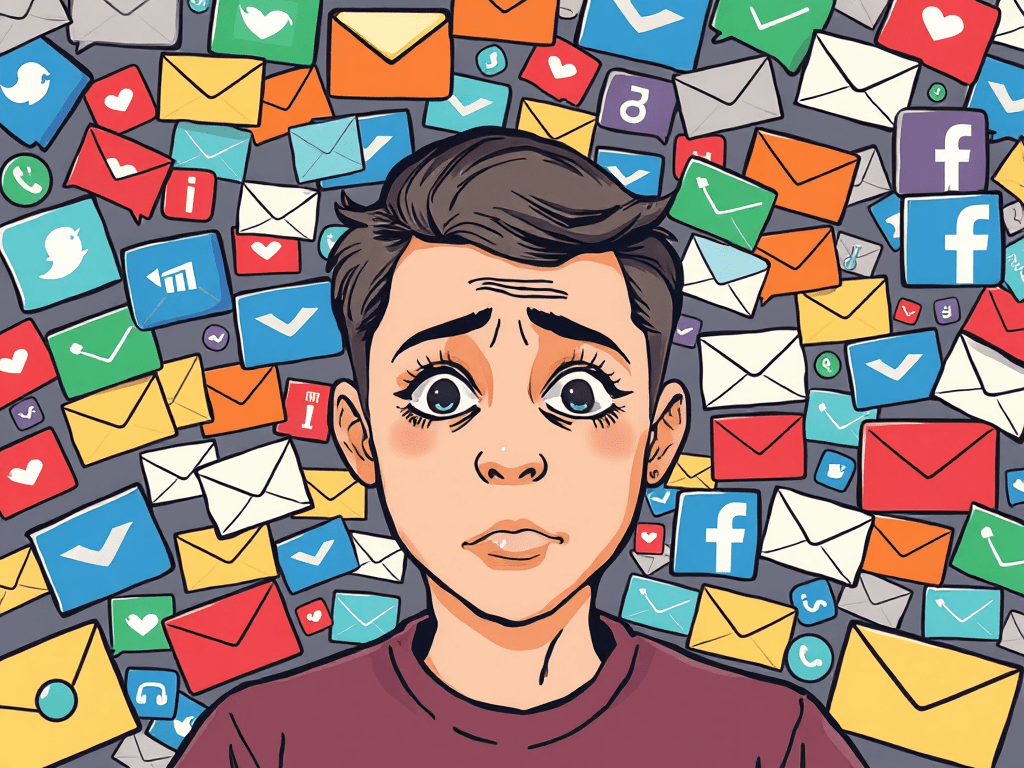
And I don’t mean the emailing platform.
Every few months, another article/video appears lamenting the rise of family estrangement, adult children going “No Contact”.
- Oprah Explores the Rising Trend of Going No Contact with Your Family
- Arthur Brooks: Family Estrangement Is a Tragedy
Adult children are cutting off their parents at alarming rates, we’re told. Therapists and social media influencers are encouraging this tragedy. Families are falling apart over political disagreements and minor slights. What’s wrong with this generation?
But these articles consistently miss what’s actually changed. The problem isn’t that more people want distance from difficult family members—that desire has always existed. The problem is that the methods we used to create that distance no longer work, and we’re mistaking the visibility of new boundary-setting strategies for an increase in the problem itself.
How No Contact Used to Work
For most of human history, managing a difficult family relationship had a simple solution: physical distance. You moved to another city, another state, another country. You called once a week or once a month. Long distance calls cost money. You visited at holidays, maybe. You exchanged letters. This wasn’t exactly no contact, but it created natural buffers that made challenging relationships manageable.
Nobody questioned this. It was just normal life. Your parents might have wished you lived closer, but a monthly phone call and annual visits was considered maintaining the relationship. The relationship existed, but with built-in protection through limited contact.
It wasn’t perfect, but it worked. The “dose” of a difficult family member was small enough that most people could handle it. You could love your overly critical parent while living 500 miles away and while having limited engagement with them. The distance wasn’t rejection—it was a survival strategy that looked like ordinary life.
The Technology Rupture
Over the past 20 years, everything changed. Cell phones, texting, social media, video calls, family group chats, location sharing. Suddenly, physical distance meant nothing.
Now that same parent expects:
- Responding to texts
- Daily check-ins/photos
- Participation in family group chats
- Reactions to Facebook posts
- Video calls
- Real-time updates on your life
- Explanations for why you’re not more available
The person who moved 500 miles away—or even a 45-minute drive across town—to create breathing room discovers it doesn’t work anymore. The buffer is gone. A relationship that once involved 10-60 interactions per year now involves hundreds or thousands of micro-interactions. The dose has increased exponentially.
If your family member is controlling, critical, guilt-tripping, boundary-crossing, or just exhausting to be around, it’s no longer a manageable number of phone calls from time to time. It’s constant invasion with no escape valve. Geographic distance, which used to be the solution, now does almost nothing.
The Double Shift
But technology alone doesn’t explain what we’re seeing. Something else has changed too: our understanding of what constitutes a healthy relationship continues to evolve.
In the 1950s, it was socially acceptable—even expected—for parents to use physical punishment freely, for fathers to be emotionally distant authority figures, and for children to simply endure whatever treatment they received. “Children should be seen and not heard” wasn’t just a saying; it was enforced reality.
By the 1980s, we’d made progress. Physical abuse was becoming less acceptable, though “spanking never hurt anyone” was still common wisdom. But emotional manipulation, constant criticism, and boundary violations were still just “how families work.” Adult children were expected to tolerate whatever behavior came their way because “that’s just how Mom/Dad is” or “you only get one family.”
Now, we recognize emotional manipulation and gaslighting as real forms of harm. We understand trauma, narcissistic patterns, codependency, enmeshment. We have language for these dynamics. We’ve learned that love can coexist with harm, that “they meant well” doesn’t erase damage, that boundaries aren’t selfish—they’re essential. We’ve stopped accepting “that’s just how family is” as a shield for harmful behavior.
This is progress. This is civilization evolving, just as we moved beyond settling disputes with duels or accepting domestic violence as a private family matter.
But here’s what makes the current moment unique: this evolution in relationship standards is colliding with technology that removed all our buffers.
Previous generations could maintain relationships with difficult people because distance made those relationships manageable. They never had to confront whether the relationship itself was healthy. A critical, controlling parent was easier to love from a distance with monthly phone calls.
Now, constant contact forces intimacy. People can’t escape anymore. You’re either accepting constant boundary violations or explicitly ending the relationship. There’s hardly any middle ground.
The technology didn’t just make existing problems worse—it made invisible problems visible. When you can’t create distance passively, you must actively evaluate: is this relationship good for me? And for the first time in history, we have frameworks and language that say it’s okay to answer “no.”
This might explain why estrangement seems so prevalent now. Forced intimacy through constant contact exposed the reality of difficult family dynamics. New frameworks for understanding relationships gave people permission to name what they were experiencing. The “No Contact movement” isn’t creating problems—it’s giving people language and strategies for problems that distance used to quietly solve.
Visibility vs. Increase
Here’s what I think is actually happening: the number of people who want significant distance from difficult family members probably hasn’t increased much at all. What’s increased is the visibility of that desire.
To achieve what previous generations got naturally through geography, you now have to explicitly block, mute, ignore, and set boundaries. And that looks different. That gets noticed.
Whether someone needs limited contact or no contact at all, they now face judgment for boundary-setting that previous generations accomplished passively and without comment.
Articles documenting “rising estrangement rates” aren’t necessarily showing that more people want distance. They’re showing that distance now requires visible action instead of gentle passivity. We’ve mistaken the visibility of boundary-setting for an increase in the problem itself.
Why the Resources Exist
When articles blame therapists, support groups, and online resources for “encouraging” estrangement, they’re getting cause and effect backwards.
These resources aren’t creating the problem. They’re teaching people how to set boundaries in a world where the old methods don’t work anymore.
Your grandparents didn’t need a guide on how to deal with difficult family members because moving to another state and calling once a week usually did the trick. That was normal and socially acceptable. Nobody needed instructions.
Now people need explicit guidance on:
- How to respond when parents demand immediate text responses
- What to say when questioned about limited social media presence
- How to navigate expectations around location sharing and constant availability
- How to set boundaries that previous generations got automatically through geography
- How to deal with the deluge of guilt-tripping, shaming, and general unpleasantness that is the MO for some individuals
Yes, there’s a market for this support. Not because coaches and therapists invented the problem, but because technology created a problem that needs new solutions. The groups and resources aren’t predatory—they’re filling a gap.
What This Means
The entire conversation about rising estrangement rates is misframed. We don’t have an estrangement crisis. We have a crisis of constant contact, and we’re calling the solutions to that crisis the problem.
We’ve removed every natural buffer that made difficult relationships manageable. We’ve created expectations for constant availability that are historically unprecedented. And then we’ve blamed the people who buckle under that pressure for being too sensitive or entitled.
We can’t have an honest conversation about family estrangement while ignoring that the infrastructure of family relationships has fundamentally changed. What looks like “rising estrangement” often represents visible boundary-setting replacing invisible geographic distancing. Resources helping people set boundaries aren’t creating the problem—they’re responding to structural changes in how families relate across distance.
The real tragedy isn’t that families are falling apart. It’s that we’re judging modern families by standards that assume tools and conditions that no longer exist.
And maybe—just maybe—we should stop judging people for the amount of distance they need, whether that’s limited contact or no contact at all.
 Ryan Cooper
Leave a comment